

Welcome to Universe World, Saevar! Tell us about yourself…
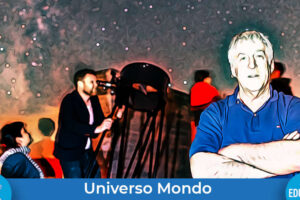
I have a background in geology but did all the astronomy and astrophysics courses at the University of Iceland that were available. I meant to continue and do graduate studies in planetary science but life happened: I had a baby and plans changed after that. Luckily, I was offered a position to teach astronomy at a local high school and do outreach and educational work for the University of Iceland. I enjoyed it immensely and kind of got stuck in it.
At the same time, media work was also increasing so I just decided to go all in in science communication and outreach. It’s been wonderful, loads of fun and fruitful, leading to multiple books, radio and prime time TV shows, meeting people from all over the world. Can’t complain.
What keeps you busy these days?
I’ve worked in multiple places, mostly teaching at local high schools and programs for the University of Iceland and a Natural Science Museum. Currently, however, I decided to go all in in my own startup company called Iceland at Night. The aim is to provide travelers that come to Iceland to search for the Northern Lights the best and most reliable tools to catch them. The same company owns Eclipse 2026 and a small shop that specializes in stargazing and astrophotography equipment.

It happened by accident, mostly. I was in my late teens when a professor at the University of Iceland recommended the media talked with me about Mars and Mars exploration. Apparently, I was told I was very good at explaining hard to understand things to people, grown-up and kids alike, with a heavy dose of enthusiasm and excitement, and so I was contacted more and more often to explain science in the media. I just find it so fun and rewarding and important to communicate science to the general public.
There also seems to be some spark or deep seated need within me to tell everyone about the wonders of the night sky and the Universe. My biggest inspiration is, of course, Carl Sagan and his amazing books and tv show.
These early media experiences eventually led you to become a TV-show host and best selling book author… how did that happen?
I’ve done a lot of work in local media, TV and radio. For example, I hosted the kids news segment for a few years which allowed me to tell kids about new discoveries in science, astronomy especially. For years, I’ve had bi-weekly segment on one of the morning shows on radio which is an awesome platform to have to communicate science.
I’ve done prime time TV series about climate change and solutions to the environmental crisis. Then I became host of one of the oldest TV show on science and technology in Iceland. It’s a privilege to be able to do it.
Writing books is probably what I love doing the most. I’ve written ten so far, six of which are part of a series on science for kids and teenagers, and then four aimed towards young adults and adults. Only one is in English so far, Iceland at Night, which I did with my friend and colleague, Babak Tafreshi, a National Geographic photographer. That one is about the night sky above Iceland and of course the Northern Lights.
I’m quite proud of the series for kids. It’s called “Science Literacy” and the subjects are very diverse: the Solar System, how humanity has solved difficult environmental issues, mistakes and the importance of not being afraid of making mistakes when you are trying something new and learning. Then it was time for history of Earth and the Big Bang and, of course, a book about what happens to our bio waste: yes, poo and pee. It sold out!

Yes, Iceland is an amazing country. The nature is unbelievable. If you want to witness the creation of our planet, Iceland is the place to be. It’s incredibly diverse. Nature was a huge influence on why I decided to study geology and wanted become a planetary scientist.
However, the night sky and the stars are my true love in nature. Nothing beats being outside in pitch black starry sky with a dancing aurora above. It’s incredibly peaceful and beautiful, awe-inspiring. I just find it so amazing that I want to tell everyone about it. It sparks something I cannot explain within me.
And yes, Iceland is known for being rather cloudy on average, but funnily enough, it’s not as bad as many people think. We very often have beautiful clear skies in fact.
Good to know! So, what are your favourite phenomena to talk about with an audience?
Solar eclipses, by far. Nothing comes close to the spectacle of a total solar eclipse. I’ve been fortunate enough to see four so far and will chase every one I possibly can in the future. Recently, I’ve been doing a lot of that which is always enjoyable and never tiresome.
After that, showing the Northern Lights to travelers is amazing. People flock to Iceland to see it. For a good reason, we see aurora pretty much every night during the aurora season from mid-August until late April. These same people often live in very light polluted places and sometimes they haven’t even seen the Milky Way ever. Being outside with them and just look up with the naked-eye and a telescope is incredibly gratifying.
Then just to be able to talk about the night sky in general, especially under the real thing at night. It’s a privilege to get paid to look up and tell people about what you love the most. I do quite a lot of it with kids and grown-ups alike.
And what’s your favourite audience?
Oooh, that’s a difficult one. All audiences have their charm, be it kids in kindergarten, teenagers or the elderly. Probably my favourites are too-cool-for-school teenagers that arrive with a negative mindsets but end up being super enthusiastic and involved. Meeting curious people of all ages is always exciting, especially so when they know a thing or two and become interested in seeing some faint faraway galaxy through the eyepiece of a telescope.
One of the objectives of a science communicator should be to spark interest in their audience and captivate them. That’s my goal at least. To teach them something new and amazing and leave them curious and wanting a bit more.

As part of your science communication efforts, you’ve shared the excitement of solar eclipses from various parts of the world. This year, a total eclipse of the Sun will graze a portion of Iceland on the 12th of August. How are you – and everybody – preparing for this extraordinary event?
I’ve been working my socks off for the past three years or so, knocking on everyone’s doors that have vested interest, be it travel companies, municipalities and the authorities. It’s been an awful lot of work. I opened eclipse2026.is two years ago to help everyone prepare, tell them what to expect and pretty much anything you can think about.
I’ve tried everything I can but despite that, I know we have already missed out on an opportunity of a lifetime because of lack of interest from the authorities and the fact that Icelanders never really plan ahead for anything until last minute, when it’s a little too late. It makes me extremely sad.
Another maybe not so surprising element is unbelievable greed. Whenever I talk about this amazing celestial event, people seem to be more interested in making as much money as possible by overpricing their houses on rental platforms.
That being said, I never give up and just try my absolutely best to share how wonderful it is and how lucky we are to be alive when the Moon’s umbral shadow crosses Iceland.
I’ve done more than a hundred talks so far to various groups, visit schools and try to use social media for outreach and education. A book for kids on eclipses is about to be released and I’m trying my best to make sure kids know how to watch the eclipse safely. Due to a total lack of support, I made an online store to sell eclipse glasses and other solar observing equipment to raise funds for educational programs. Fortunately, the general public seem to appreciate it and it’s helped a lot.
Thanks to my efforts, every municipality has started preparations. It mostly revolves around traffic control and safety though but still, at least they know what is about to happen. I keep my fingers crossed for excellent sky on the big day. I really, really wish for that.
Do you have any tips for people planning to experience the eclipse in Iceland?
Yes: be mobile. Iceland is often cloudy but rarely completely overcast everywhere. That’s why being mobile is absolute key.
Then be patient because traffic will be awful. But my main tip is just enjoy being in Iceland. It’s an amazing place with wonderful nature, excellent food and hopefully wonderful people too.
I recommend using eclipse2026.is for practical info that will be added when the event draws nearer.

Tell us more about astronomy in your country.
Astronomy is mostly done abroad. Icelandic astronomers work at the University of Iceland and cooperate heavily with other astronomers from all over the world, particularly in the other Nordic countries. We’ve been members of the Nordic Optical Telescope since the 1990s.
For the past couple of decades, the main research topics have been high energy astrophysics like gamma ray bursts and black holes – and more recently, dark matter and dark energy. Locally, most astronomical research has revolved around magnetic field observations and Northern Lights research.
Of course, we’ve contributed quite a lot to planetary sciences. Iceland is a very popular spot for other scientists to do field studies, try out equipment and prepare for exploring the Moon, Mars and Venus, even the icy moons in the Solar System. For example, the Artemis crews have done training in the Icelandic highlands, just like the Apollo astronauts did in 1965 and 1967. Iceland is a great analog for studying the Moon, Mars and Venus.
And what about science education and communication?
I guess we have a similar situation as other European countries when it comes to science education and communication. Natural science, like geology, biology, physics, chemistry, is of course mandatory in elementary school and high school. Unfortunately, the teachers seldom do have a background in science but I know they try their best and are very keen on educating themselves whenever they have the opportunity to do so. Basic astronomy is often taught as part of either physics or geology and every student gets at least a bit of astronomy in elementary school.
Science communication is of various degrees in Iceland. Of course, being a volcanic country, geology and geophysics is the number one topic being communicated to the general public. So much so that almost everyone is an “expert” on volcanoes nowadays.
Other science communication is done in various ways, be it in the media, talks or on social media.

Complete lack of funds is the biggest challenge. Most of science communication efforts is a private enterprise, done without being paid to do so and sometimes seen as a hobby of a scientist or a science communicator. When it comes to education, teachers often use their spare time to educate themselves on science. I can’t but applaud them for their efforts.
Nowadays, social media is a major challenge given the amount of misinformation spread online. I myself get asked frequently about some nonsense people saw on social media, which is either completely exaggerated or just plain wrong. It’s taking up more and more of my time, unfortunately.
Using different platforms is also a major challenge: you have to learn video editing to be able to reach out to people.
Language is another, perhaps a bit more surprising challenge. English is all-encompassing that people nowadays don’t know the Icelandic words anymore. Especially kids. Nowadays, when I am explaining something, I often have to say the term in English before telling them the term in Icelandic. It’s a pity, I think.
You are also part of the International Astronomical Union’s (IAU) network of astronomy outreach and education. How do you think these challenges differ from those encountered in other countries around the world?
I think Europe and the US share similar problems. Lack of time and funds and the spread of misinformation made even worse now with unreliable Large Language Models (LLMs). I also think that distrust in science and expertise is something I very much worry about. Perhaps we need to change in some way how we communicate and educate. How, I don’t know. Sometimes, professors and esteemed scientists are not the best communicators.
For example, I’ve seen and read interviews with astronomers talking about total solar eclipses without ever seeing one. You cannot communicate enthusiastically the awesomeness of the eclipse experience without having ever seen one.

The most exciting is definitely seeing kids becoming curious and enthusiastic about something they didn’t really know of or care about before. Changing their perspective on how beautiful and interesting nature is. How exciting science can be and who it arms you with a way of thinking that can help you a lot when you’ve grown up. Besides that, just sharing the wonders of the night sky with ours is always exciting.
The most difficult part I guess would being surrounded by negative people. Fortunately, that’s rare but it happens.
When it comes to communicating the excitement of the upcoming total eclipse, I’d say the most difficult thing has been to convince people that it will be awesome no matter how the weather will be. And that it is absolutely worthwhile making the most out of a unique experience we’ll never have in again in our lifetimes. In that part, the lack of support and interest from the authorities has been most disappointing.
Earlier, you mentioned Carl Sagan. Are there any other authors, books, people or special events that influenced you along your journey?
Oh yes. So many. First, seeing Cosmos by Carl Sagan when I was only eight years old, completely fascinated. My uncle had a telescope around the same time and he showed me Saturn through it for the first time. I was just speechless, couldn’t believe that I could see its rings. Or the craters and mountains on the Moon! The more I learned, the more fascinated I got and the more excited about sharing that excitement with others.
My life changed on March 20th 2015 though. We had a very deep partial solar eclipse in Iceland that Friday morning, a 97% eclipse in Reykjavík and 99% in East Iceland. A few months before, I had gotten this crazy idea of giving every student and teacher in Iceland eclipse glasses so that they could go outside that morning and see a beautiful solar eclipse. Such a deep partial eclipse that you would feel the temperature drop, the wind change and the eery silvery light. It would take place during school hours and instead of being kept inside, why not change the day to a science education event.
Luckily, the weather cooperated. That morning was the only clear morning in the whole of Iceland that March. And so, every student and every teacher went outside and looked safely at a solar eclipse.
That event completely changed my life. It lead to all the books and TV and radio shows, even science themed concerts with the Icelandic Symphony Orchestra.


Add Comment